
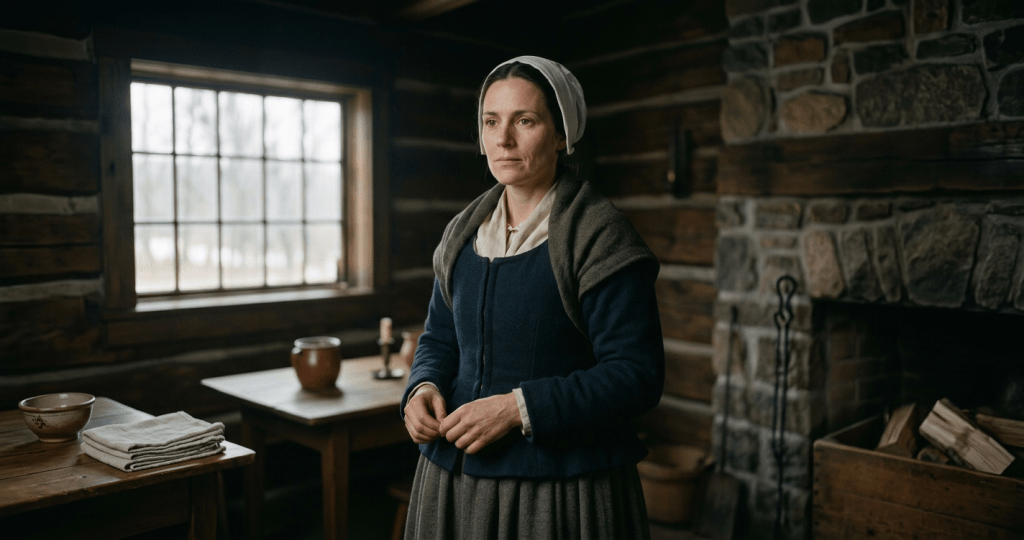
Full Name: Marie Bourdon (also recorded as Marie Baudon)
Birth Date: March 5, 1633
Death Date: April 15, 1705
The Matriarch of Notre-Dame: The Exceptional Life of Marie Bourdon
From the Steeples of Rouen to the Edge of the World (1633–1650)
Marie Bourdon was born on March 5, 1633, in the historic city of Rouen, the bustling, cathedral-dominated capital of Normandy, France. She was baptized that very same day within the ancient stone walls of the parish church of Saint-Candé-le-Vieux. She was the daughter of Louis Bourdon and Marguerite Prunier. Raised in a major urban center under the shadow of intense religious and political transformation, Marie was a literate woman of status whose family ties connected her as a cousin to Jean Bourdon, the famed Chief Engineer, surveyor, and Attorney General of New France. It was likely through this influential family connection that Marie, as a fiercely independent teenager of just fifteen, made the monumental decision in 1648 to board a ship and cross the Atlantic Ocean to the rugged frontier of Quebec. [1, 2, 3]
The First Household: Life with Jean Gloria (1651–1665)
In the tiny, fortified settlement of Quebec, Marie’s presence as an educated Frenchwoman made her an elite, eligible bride. On December 27, 1651, she executed a formal marriage contract, and on January 9, 1652, she wed Jean Gloria at the parish church of Notre-Dame de Québec. Gloria was an important figure in the young colony—a merchant, tailor, and royal notary. Together, Marie and Jean established a prominent household in the Lower Town of Quebec, where they welcomed nine children into the world. Marie was not merely a housewife; records indicate she actively participated in her husband’s mercantile transactions, and her daughters later worked as merchants on the historic Rue du Cul-de-Sac. The family took a devastating blow in the autumn of 1665 when Jean Gloria passed away. Left a young widow with a large house and multiple fatherless children, Marie had to navigate the strict legalities of the sovereign council to secure her children’s inheritance while managing the family estate alone. [1, 2, 3, 4, 5]
The Second Chapter: The Toupin Alliance (1666–1673)
Recognizing that survival and status on the frontier required a shared partnership, Marie remarried a few years later. On June 3, 1669, she returned to Notre-Dame de Québec to marry Toussaint Toupin dit Duchesne. Toupin was a wealthy, respected master ship captain and merchant who also held the title of seigneur. In an extraordinary testament to how New France families intertwined, it was a celebrated double wedding: on the exact same day in the same church, Marie’s daughter, Marie Gloria, married Toussaint’s son, Jean-Baptiste Toupin. Through this marriage, Marie’s social standing elevated significantly, managing a prosperous estate, integrating her existing children with Toupin’s family, and giving birth to three more children. However, this period of stability was cut short when Toussaint Toupin passed away in August 1676. Marie’s life took a remarkably complex turn shortly before his death when she temporarily returned across the Atlantic to her ancestral homeland in France. [1, 2, 3, 4, 5]
An Ocean Crossing and a Frontier Scandal (1674–1679)
In a rare move for early colonial women, Marie journeyed back to Normandy, where archival records place her contracting a brief, enigmatic marriage or legal arrangement in the parish of Gerponville. By 1674, however, she was back in New France, where she became the center of a dramatic societal scandal. Now in her early forties, the wealthy dowager entered into a romantic relationship with a much younger man: twenty-year-old Jean Lehoux dit Laliberté. Because they were not formally wed under the eyes of the Church, their union caused a stir in the highly pious colony. Out of this relationship, Marie gave birth to a son, Nicolas Lehoux dit Laliberté, in 1674. Despite the societal whispers, Marie fiercely protected her independent property rights and ensured her new son was legally acknowledged and cared for. [1, 2]
A Quiet Harbor in Château-Richer (1680–1705)
Seeking a peaceful final chapter away from the bustling court battles and politics of Quebec City, Marie moved downriver to the Beaupré coast. On November 8, 1680, she signed her final marriage contract, marrying Jean Charet (also spelled Charest) three days later on November 11. Their wedding took place in the parish of La Visitation-de-Notre-Dame in Château-Richer—the very first rural parish established in New France. Jean Charet was a quiet, hard-working widower and toolmaker who provided Marie with the peaceful, stable life she desired for her twilight years. Though no children were born of this final union, Marie spent the next two decades watching her sprawling network of children from her various relationships marry into the foundational families of the colony, including the Toupin, Caron, and Roussin lines. [1, 2]
Marie Bourdon’s extraordinary journey through a shifting world ended on April 15, 1705. At the advanced age of seventy-two—having survived two transatlantic voyages, multiple cholera outbreaks, and the dangerous realities of colonial childbirth—she passed away in Château-Richer. She was buried the same day in the parish cemetery. From the sophisticated streets of Rouen to the wild shores of the St. Lawrence, Marie left an indelible mark on Canadian history as a woman of immense grit, legal savvy, and exceptional independence. [1]
References and Sources
- Registres de la paroisse de Saint-Candé-le-Vieux de Rouen, France (Baptismal Records, 1633).
- Registres de la paroisse de Notre-Dame de Québec (Marriage and Baptismal entries, 1652 and 1669).
- Registres de la paroisse de La Visitation-de-Notre-Dame, Château-Richer (Burial Records, 1705).
- Greffe de notaire Guillaume Audouart et Romain Becquet (Notarial Marriage Contracts, 1651, 1669, and 1680).
- WikiTree Free Family Tree, Marie Bourdon (1634–bef.1706).
- NosOrigines Généalogie du Québec, Marie Bourdon & Toussaint Toupin Profiles.
- FamilySearch International, Marie Bourdon (1633–1705) – Ancestors Profile.
- Jetté, René. Dictionnaire généalogique des familles du Québec. Les Presses de l’Université de Montréal, 1983.
- Provost, Honorius. Bourdon, Jean. Dictionary of Canadian Biography, vol. 1, University of Toronto/Université Laval, 1966.
- Recensements nominatifs de la Nouvelle-France (Censuses of New France for 1666, 1667, and 1681). [1, 2, 3, 4]



 Related to Me
Leave a comment