
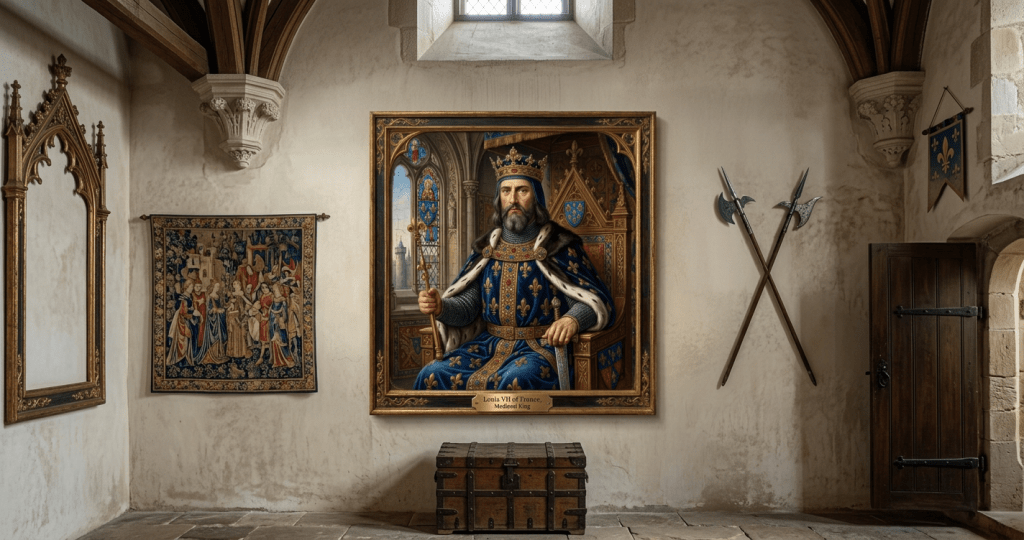
Name: Louis VII of France
Title: King of France from 1137 to 1180
Birth: 1120.
Marriages:
Eleanor of Aquitaine (1137; annuled 1152)
Constance of Castile (1154; died 1160)
Adela of Champagne (1160)
Death: 18 September 1180, Paris.
The Pious Monarch: The Life and Reign of King Louis VII
Chapter I: The Accidental Heir (1120–1137)
Louis VII was born in 1120, the second son of the formidable Capetian monarch Louis VI (the Fat) and Adelaide of Maurienne. Cloistered away during his youth in the abbey of Saint-Denis, Louis was raised strictly for the cloth. He developed a brilliant mind for theology, a deeply ascetic nature, and a lifelong, foundational friendship with Abbot Suger.
Fate intervened brutally in October 1131. His older brother, Philip, died in a freak accident when a stray pig ran into the path of his horse in Paris. Thrust suddenly into the position of crown prince, the monkish Louis was entirely unprepared for the ruthless arena of medieval geopolitics. He was crowned as co-ruler days later by Pope Innocent II at the Council of Reims. When his father passed away in August 1137, 17-year-old Louis took total command of the kingdom.
Chapter II: A Doomed Union and the Flames of Vitry (1137–1146)
Just weeks before his father’s death, on July 25, 1137, Louis was wed to Eleanor, Duchess of Aquitaine, the wealthiest heiress in Europe. The match united the tiny Capetian crown lands with the sprawling, wealthy territories of southwest France. However, the pairing of the austere, deeply spiritual king and the vibrant, strong-willed duchess was immediate friction. Eleanor famously complained that she believed she had married a king, only to find she had “married a monk.”
The early years of Louis’s sole reign were marked by stubborn pride. He aggressively clashed with Pope Innocent II over who had the right to appoint the Archbishop of Bourges. When Louis swore on holy relics that the papal nominee, Pierre de la Châtre, would never enter the city, the Pope placed the royal lands under a strict papal interdict.
The feud escalated into an all-out war with Theobald II, Count of Champagne, who championed the Pope’s cause. In 1143, Louis’s royal armies brutally stormed the town of Vitry-le-François. During the siege, the royal troops set fire to the town, and over 1,300 townspeople who had sought sanctuary inside the parish church were burned alive. Hearing the screams of the dying from his tent, Louis was shattered by profound guilt. The horror of Vitry broke his stubborn spirit; he immediately sued for peace, accepted the Pope’s archbishop, and sought a grand pathway to atone for his mortal sins.
Chapter III: The Disastrous Second Crusade (1147–1149)
On Christmas Day 1145, Louis announced his intention to take up the cross. His vow caught fire across Europe, fueled by the soaring rhetoric of Bernard of Clairvaux at Vézelay. In June 1147, Louis and Queen Eleanor set off on the overland route to Syria, leading a massive French host. Along the way, they stopped in the Kingdom of Hungary, where King Géza II warmly welcomed them and asked Louis to serve as the baptismal godfather to his son, Stephen.
The expedition quickly turned into a logistical and military nightmare. In early 1148, while traversing the treacherous mountains near Laodicea, the French vanguard lost contact with the main force. Turkish forces ambushed the column, showering them with boulders and arrows. Louis’s personal royal guard was entirely annihilated. The king saved his own life by scaling a steep cliff face, gripping exposed tree roots while fighting off attackers with his bloody sword.
Crucial Moments of the Second Crusade================================================================================Easter 1146 ------------ Bernard of Clairvaux preaches the Crusade at VézelayJune 1147 -------------- Louis VII and Eleanor depart with the French army from MetzJanuary 1148 ----------- Disaster at Laodicea; Louis narrowly survives a Turkish ambushMarch 1148 ------------- The royal couple arrives in Antioch; marital rift deepensJuly 1148 -------------- The catastrophic Siege of Damascus completely failsApril 1149 ------------- Louis and Eleanor abandon the Holy Land, returning in separate ships
The fractured army finally limped into Antioch. There, Eleanor sided with her charismatic uncle, Raymond of Antioch, who urged Louis to launch a campaign against Aleppo. Louis refused, choosing instead to march south to Jerusalem. The Crusade reached its pathetic climax in July 1148 when Louis, Conrad III of Germany, and Baldwin III of Jerusalem launched a hopelessly botched Siege of Damascus. The siege was abandoned after just four days. Louis returned to France in 1149, his treasury entirely empty, his military reputation destroyed, and his marriage completely broken.
Chapter IV: The Rise of the Angevin Shadow (1152–1160)
The deep-seated fractures between the royal couple culminated in March 1152 at the Council of Beaugency, where their marriage was officially dissolved on the pretext of consanguinity (kinship). While they left the marriage with two daughters, Marie and Alix, Louis’s failure to secure a male heir proved a strategic disaster.
Just eight weeks later, Eleanor shocked Europe by marrying Louis’s fiercest rival: Henry, Count of Anjou. By doing so, Eleanor transferred the massive Duchy of Aquitaine into Angevin hands. When Henry ascended the English throne as King Henry II in 1154, he controlled an empire that stretched from Scotland to the Pyrenees, completely surrounding and eclipsing the tiny French royal domain.
                  THE GEOPOLITICAL IMBALANCE (c. 1160)
=========================================================================
[ THE ANGEVIN EMPIRE ]                     [ THE CAPETIAN REALM ]
Controlled by: Henry II & Eleanor          Controlled by: King Louis VII
Territories:                               Territories:
  * Kingdom of England                       * Île-de-France (Paris region)
  * Duchy of Normandy                        * Small royal fiefs
  * Anjou, Touraine, & Maine                 * Nominal suzerainty over
  * Duchy of Aquitaine                         unruly independent dukes
=========================================================================
Louis tried to launch campaigns against Henry for marrying his vassal without royal consent, but the French forces were repeatedly outmaneuvered, out-funded, and routed. Desperate for an heir, Louis married Constance of Castile in 1154, but she bore him only two daughters before dying in childbirth on October 4, 1160. Desperate, Louis married his third wife, Adela of Champagne, a mere five weeks later.
Chapter V: The Golden Autumn of the Monk King (1160–1180)
Though Louis lacked the vast resources of the English king, he learned to fight Henry II through clever, indirect diplomacy. He offered sanctuary to Henry’s exiled enemies, most notably the rebellious Archbishop of Canterbury, Thomas Becket, and later provided safe harbor and funding to Henry II’s own sons during their great family rebellion of 1173–1174.
On August 21, 1165, after nearly three decades of desperate praying and three marriages, Adela of Champagne gave birth to a son: Philip, justly nicknamed Dieudonné (God-given). The succession of the House of Capet was finally secure.
The Cultural and Architectural Legacy of Louis VII================================================================================1163 ------------------- Louis VII attends the laying of the cornerstone of Notre-Dame de Paris1160s ------------------ Institutionalization of the University of Paris (The Sorbonne)1179 ------------------- Final pilgrimage to the shrine of Thomas Becket at Canterbury1180 ------------------- Death of Louis VII; burial at Barbeau Abbey (later moved to Saint-Denis)
While his foreign policy was a bitter struggle against the Angevins, Louis’s domestic reign laid the groundwork for the golden age of France. In 1163, he stood proudly alongside Pope Alexander III to lay the cornerstone for the construction of Notre-Dame de Paris. He granted royal charters that institutionalized the University of Paris, transforming the city into the intellectual capital of the Christian world.
In late 1179, a stroke left the aging king partially paralyzed. On September 18, 1180, King Louis VII passed away in Paris at the age of 60. He was buried at Barbeau Abbey, leaving behind a compact, stable, and deeply pious state to his brilliant son, Philip II Augustus, who would use the foundations his father built to smash the Angevin Empire and remake France into a European superpower.





 Related to Me
Leave a comment