
The Plowman of Perche: The Life of Robert Boulay
Roots in the Orchards of Perche (1631–1662)
Robert Boulay was born around 1631 in the historic, rolling hills of the Perche region in Normandy, France. He grew up in the parish of Saint-Germain-de-Loisé, a rural area tightly bound to the bustling market town of Mortagne-au-Perche. According to authoritative French archival records like the Fichier Origine, Robert came from deep local stock. He was the son of Marin Boullay—who had been baptized in the parish of Notre-Dame in Mortagne back in 1589—and Charlotte Gratessac. His paternal grandparents, Marin Boullay Sr. and Madeleine Creste, had been established merchants in the region. [1, 2, 3, 4, 5]
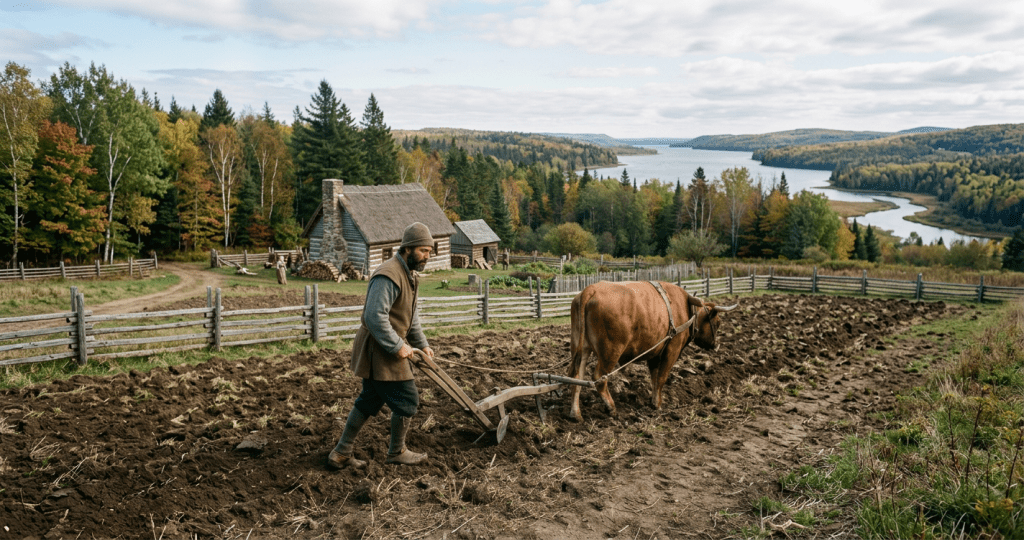
Robert was raised to work the land, mastering the grueling and vital trade of a laboureur, or skilled plowman. On January 11, 1657, he married Françoise Grenier (often recorded as Garnier) in the nearby village of Bivilliers. Over the next few years, they began their family under increasingly difficult economic conditions. Their firstborn daughter, Jacqueline, was born on April 9, 1659, in Loisé, followed by a son, Jean, who was baptized in September 1661 in the neighbouring parish of Coulimer. By 1662, a devastating famine swept through Perche, leaving parish registries filled with accounts of starvation. Realizing that Europe offered little future for his young children, the headstrong plowman turned his gaze toward the promises of the New World. [1, 2, 3, 4]
Crossing the Atlantic and Taming the Île d’Orléans (1663–1680)
In the spring or summer of 1663, the Boulay family boarded a transatlantic vessel bound for New France. The voyage was long and perilous, but on November 16, 1663, the ships finally dropped anchor in the cold waters of Quebec City. Robert, Françoise, and their young daughter Jacqueline stepped onto the shores of a vast, forested frontier. Tragically, their infant son Jean does not appear in Canadian records and likely succumbed to the hardships of the ocean crossing or died shortly before departure.
Seeking land to cultivate, Robert crossed the St. Lawrence River to the Île d’Orléans. On November 6, 1663—just days after arriving—he secured a land concession of three arpents in front of the river in the parish of Sainte-Famille from Charles de Lauzon de Charny. The early colonial censuses of 1666 and 1667 show the family working tirelessly to clear the ancient forest. By 1667, they had successfully broken six arpents of wild land into arable soil and managed five head of cattle. As the years progressed, their family grew significantly; Robert and Françoise would welcome a total of ten children, expanding their small household into a vibrant pioneering clan. To optimize his holdings, Robert sold his northern island property to Jean-Galleran Boucher in 1670 and moved to a southern concession in the parish of Saint-Jean, which he farmed until selling it to Pierre Mourier in late 1675. [1, 2, 3]
A New Frontier in Montmagny (1681–1707)
Seeking an even larger estate for his growing sons, Robert decided to leave the island entirely and move downriver to the south shore of the St. Lawrence. On June 19, 1681, he received a grand tract of land from the local seigneur, Jean-Baptiste Couillard de Lespinay, located in the Seigneury of Rivière-du-Sud (modern-day Montmagny, Quebec). Robert and his family packed their belongings and moved immediately, becoming some of the earliest foundational pioneers of the Montmagny region. [1, 2]
The 1681 census of New France caught a snapshot of Robert at fifty years old, firmly established on his new mainland homestead alongside Françoise and their children. He had five arpents of land under active cultivation and a growing herd of livestock. In this close-knit community, his children grew, married into prominent local families, and built their own farms. His youngest son, Paul, was born on this southern shore, and his daughter Françoise was even sent to study with the prestigious Ursuline nuns in Quebec City. [, 2]
After nearly forty-four years of carving a civilization out of the Canadian wilderness, the old plowman’s long journey came to a peaceful end. Robert Boulay passed away at the age of seventy-six on March 24, 1707, at his home in Montmagny, having received the final holy sacraments of the Church. He was buried the following day in the parish cemetery of Saint-Thomas-de-la-Pointe-à-la-Caille. His beloved wife Françoise followed him to the grave two years later. Through their grit and determination, this humble couple from Perche left behind an enduring legacy, serving as the ancestral root for thousands of Boulay, Boulet, and Boulé families across Canada and the United States today. [1, 2, 4, 5]
References and Sources
- Fichier Origine, Record No. 240502 (Robert Boulay / Boulet).
- Registres de la paroisse de Saint-Thomas-de-la-Pointe-à-la-Caille, Montmagny (Burial Records, 1707).
- Registres paroissiaux de Saint-Germain-de-Loisé, de Notre-Dame de Mortagne, et de Saint-Pierre de Coulimer, France (Parish and Baptismal entries, 1589–1661).
- Recensements nominatifs de la Nouvelle-France (Censuses of New France for 1666, 1667, and 1681).
- Jetté, René. Dictionnaire généalogique des familles du Québec. Les Presses de l’Université de Montréal, 1983.
- White, Stephen A. Dictionnaire généalogique des familles acadiennes (Contextual comparative data for regional migrations).
- Archives Nationales du Québec (Land concessions for Île d’Orléans and Rivière-du-Sud, 1663 and 1681).

 Related to Me
Leave a comment