
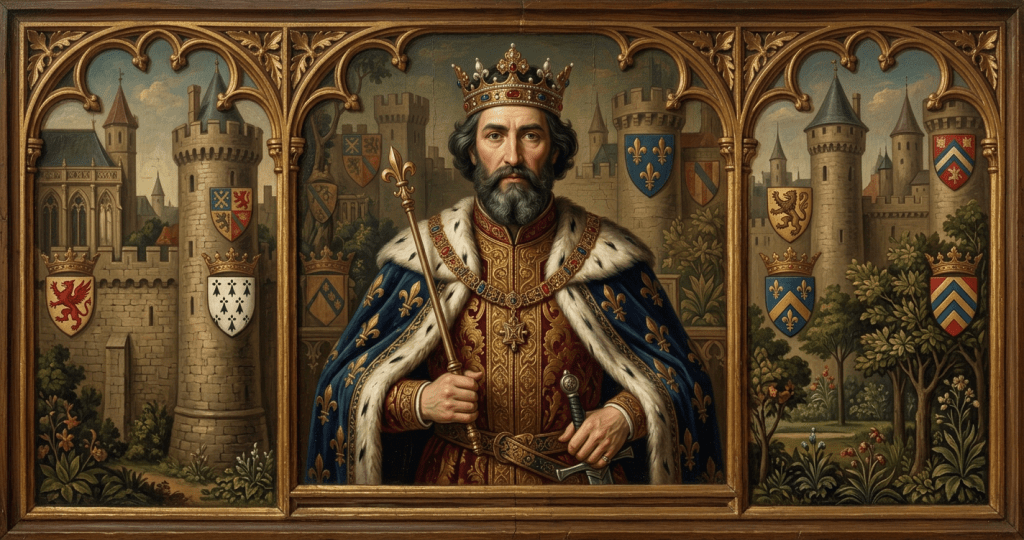
Name: Philippe Ier ‘l’Amoureux’
Title: King of France (August 4, 1060–July 29, 1108)
Dynasty: Capetians
Date of birth: May 23, 1052
Date of death: July 29, 1108(at 56 years old)
Place of death: Melun Castle ( Kingdom of France )
Burial: Abbey of Saint-Benoît-sur-Loire
Father: Henry I
Mother: Anne of kyiv
Spouse:
Bertha of Holland ( d. 1072 – 1093 )
Bertrade de Montfort ( d. 1092 – 1108 )
Children: Constance of France,
Louis VI, Henry of France, Charles of France, Odo of France
The Legacy of King Philippe I: The Amorous Monarch of the Capetian Dawn
Chapter I: An Exotic Heir and Two Regents (1052–1066)
The direct line of the Capetian dynasty shifted dramatically on May 23, 1052, with the birth of Philippe I. He was the eldest son of King Henri I of France and Princess Anne of Kiev. His mother brought a rich Eastern Orthodox heritage to the western court from the kingdom of Kievan Rus’. Breaking centuries of traditional European naming conventions, she bestowed upon him the exotic Greek name Philippos—meaning “lover of horses”—introducing a name that would become a staple among Western European royalty. [1, 2, 3]
As a vulnerable child-heir, Philippe was consecrated and crowned as king at the Cathedral of Reims in 1059 while his father still lived, a standard Capetian practice designed to secure the succession. When King Henri I died the following year in 1060, the eight-year-old boy inherited a fragile crown surrounded by powerful, highly independent regional lords. His minority was guided by two successive regents: first, his mother Anne, who broke tradition as the first queen of France to act as an official regent; and second, his powerful uncle-in-law, Count Baldwin V of Flanders. Together, they successfully safeguarded the royal domain until Philippe reached his majority at age fourteen in 1066. [1, 2, 3, 4, 5]
Family Tree:
- Parents: King Henri I of France married Anne of Kiev
- Crown Prince: King Philippe I (1052–1108) [1]
- First Marriage (1072, repudiated 1092): Bertha of Holland
- Second Marriage (1092, bigamous scandal): Bertrade de Montfort
- Children: Philippe (Count of Mantes), Fleury (Seigneur of Nangis), Eustachie (married Count of Étampes)
Chapter II: Pragmatic Rules and Royal Consolidation (1066–1091)
Taking active command of his kingdom, Philippe adopted a cautious, pragmatic policy of internal consolidation rather than sweeping, aggressive military expansion. Finding his lands dwarfed by mighty vassals—most notably William the Conqueror, Duke of Normandy, who seized the throne of England in 1066—Philippe relied heavily on strategic regional alliances, church relationships, and careful family diplomacy to defend Capetian interests. He masterfully exploited rivalries among his neighbors, playing the sons of William the Conqueror against one another. Through careful management, he succeeded in adding vital, permanent pieces to the royal domain, securing the strategic Vexin region along the Norman border and purchasing the valuable Viscountcy of Bourges. [1]
To strengthen political boundaries to his north, Philippe married Bertha of Holland in 1072. She bore several children, ensuring the royal succession with the birth of his eldest son and future heir, Louis, alongside a daughter, Constance. Yet, despite providing the required heirs, the political necessity of the match eventually faded, and a looming personal obsession began to undo the hard-won stability of the French court. [1, 2]
Chapter III: A Fatal Passion and Pan-European Scandal (1092–1104)
By 1092, Philippe’s marriage to Bertha had deeply deteriorated, and the king became profoundly consumed by desire for Bertrade de Montfort, the beautiful wife of his vassal Fulk IV, Count of Anjou. In a shocking maneuver that violated canon law and ignited an immediate pan-European scandal, Philippe effectively abducted Bertrade, repudiated Bertha by sending her away to Montreuil-sur-Mer, and entered into a bigamous union with his vassal’s wife. [1, 2, 3]
The Catholic Church responded with immediate, furious condemnation. Because Philippe flatly refused to abandon Bertrade, he was repeatedly excommunicated by Pope Urban II and various local church councils. This spiritual ban functionally barred the king of France from taking up the cross or playing any formal leadership role in the historic First Crusade of 1096. While the great lords of Europe marched off to claim glory in Jerusalem, the king of France was forced to remain behind, leaving the leadership of the French contingents to his lesser barons and his younger brother, Hugh of Vermandois. [1]
Timeline of Philippe I’s Reign and Controversies:
- 1052: Born to King Henri I and Anne of Kiev
- 1059: Crowned as child-co-king at Reims
- 1060: Becomes sole king; minority regency begins
- 1072: Marries Bertha of Holland to secure northern alliances
- 1081: Birth of his heir, the future Louis VI
- 1092: Repudiates Bertha; enters bigamous union with Bertrade de Montfort
- 1094: Formally excommunicated by the Council of Autun
- 1095: Excommunication renewed by Pope Urban II at the Council of Clermont
- 1104: Takes a solemn public oath of penance; papal ban finally lifted
- 1108: Passes away at Melun at age 56 [1, 2, 3, 4, 5]
Contemporary chroniclers noted that as he became consumed by his passion, Philippe began to lose interest in the daily, grueling administration of the state. He became physically heavy and lethargic, allowing his sharp, handsome features to waste away. For over a decade, the king played a dangerous game of cat-and-mouse with the papacy, making hollow promises to separate from Bertrade to temporarily lift the interdict, only to return to her bed immediately afterward. The bitter gridlock finally dissolved in 1104 when Philippe and Bertrade took a public, solemn oath of penance in Paris, promising to live apart, though they quietly remained close companions until the end of his life. [1]
Chapter IV: The Passing of the Amorous King (1104–1108)
In his final years, acknowledging his failing health and the weight of his tumultuous spiritual life, Philippe gradually stepped back from frontline governance. He consolidated control over the immediate crown lands around Paris and the Île-de-France, leaving broader military expeditions and the enforcement of royal justice to his capable, energetic, and well-loved son, Louis. [1]
The Steady Consolidation of the Crown:
- Inherited Realm (1060): Fragmented royal authority, over-mighty independent regional dukes, direct control heavily restricted to Paris, and weak royal domain resources.
- Completed Realm (1108): Secure control of Paris and the Île-de-France, added the critical Vexin region to the boundaries, added Bourges to expand southern influence, and a secure succession via Louis VI. [1]
Philippe I passed away at the royal castle of Melun on July 29, 1108, at approximately 56 years of age. He had ruled France for nearly 48 years, an extraordinarily long tenure that marked the longest Capetian reign until the 17th century. Out of a deep sense of humility, and a lingering feeling that his scandalous, bigamous life made him unworthy to rest alongside his ancestors at the royal Basilica of Saint-Denis, he requested to be buried at the Abbey of Saint-Benoît-sur-Loire. [1, 2, 3]
Though his turbulent personal life earned him the historic nickname l’Amoureux (the Amorous), his long reign served as an essential bridge of stabilization across half a century. By modernizing administration and ensuring a smooth transition to his successor, King Louis VI “the Fat,” Philippe laid the institutional foundations that allowed the House of Capet to eventually forge a powerful, centralized French state. [1]
References:
- Fliche, Augustin. (1912). “Le Règne de Philippe Ier, Roi de France (1060-1108).” Paris: Société Société Française d’Imprimerie et de Librairie. (The definitive historical text on his administration and the Bertrade scandal).
- Bradbury, Jim. (2007). “The Capetians: Kings of France, 987-1328.” London: Hambledon Continuum. (Contextual data on the stabilization of the royal domain).
- Orderic Vitalis. “The Ecclesiastical History of England and Normandy.” (Contemporary 12th-century chronicle detailing Philippe’s physical decline and excommunication).
- Hallam, Elizabeth M., and Everard, Judith. (2001). “Capetian France, 987-1328.” London: Longman. (Analysis of the administrative changes and relationships with the Anglo-Norman realm).
- Foundation for Medieval Genealogy (FMG). “Medieval Lands: Kings of France, Capet (987-1328).” (Sacramental, matrimonial, and lineage data for Philippe’s children).
- Abbot Suger of Saint-Denis. (c. 1144). “The Deeds of Louis the Fat.” (Primary source material regarding the transition of power from the aging Philippe I to his son Louis VI).





 Related to Me
Leave a comment